foucault
the order of things
preface
the foreword also has some interesting remarks but idgaf
we use things without thinking about it, foucault is trying to make us notice. the framework that makes the world seem intelligible
what makes a particular way of organizing things seem natural, reasonable, or scientific in a particular historical period?
borges:
animals are in categories based on ownership, physical condition, imaginary existence, incidents…
these categories are understandable individually, foucault is unsettled by the idea of their combination.
these classifications rely on arrangements of similarities and differences. how do these arrangements change historically? foucault calls this “archaeology.” rather than a story of science improving steadily, he focuses on conditions that make knowledge possible.
controversally, “man” is considered as a particular object that is the foundation of knowledge. man emerged historically and could disappear → meaning a configuration of knowledge, not just the extinction of the species.
the underlying framework
we arrange and sort things in a way that makes sense to us. we sort our books by categories, clothes by season / color / purpose… these arrangements do not change what they are, but their relationships change. two books belong next to eachother under some rule.
some of these rules may seem obvious, it would be dumb to organize your library by color, however this just might be the norm in some society.
within a system: where does this book belong?
about the system: why is this the kind of relationship we look for?
table
| author | date | price |
|---|---|---|
| .. | .. | |
| . | . | . |
before completing a spreadsheet, columns take our attention, this table is conceptual. a shared space in which things can be compared and assigned places. doesn’t have to be a literal excel sheet.
imagine if this spreadsheet changed column headings continually between different kinds of questions with no stable relationship. the taxonomy would be crazyyyyyy
vocab because im practically retarded
juxtaposition place of a thing besides another thing
propinquity proximity
tabula surface for arranging things
positive or positivity isnt meant to be understood as good/optimistic. a useful first approximation is knowledge’s definite, actual existence: the forms in which it becomes established.
also archaeology is referred to as an image of uncovering buried layers, and whats investigated is knowledge.
heteroclite: composed of disparate things that dont naturally fit together.
our utopia here is an imaginable place with a coherent arrangement, and heterotopia is an arrangement that unsettles our ability to establish common order.
Las Meninas
right off, I have no fucking idea whats he on about. I had to skim through instead of actually reading it because the whole part mturned everything familiar into something unfamiliar.
the impression I got is of an “alien narrator.”
I recognize a painter, a mirror, people in the room, he keeps asking what relationships between them make the picture work. the painting becomes a way of investigating representation itself.
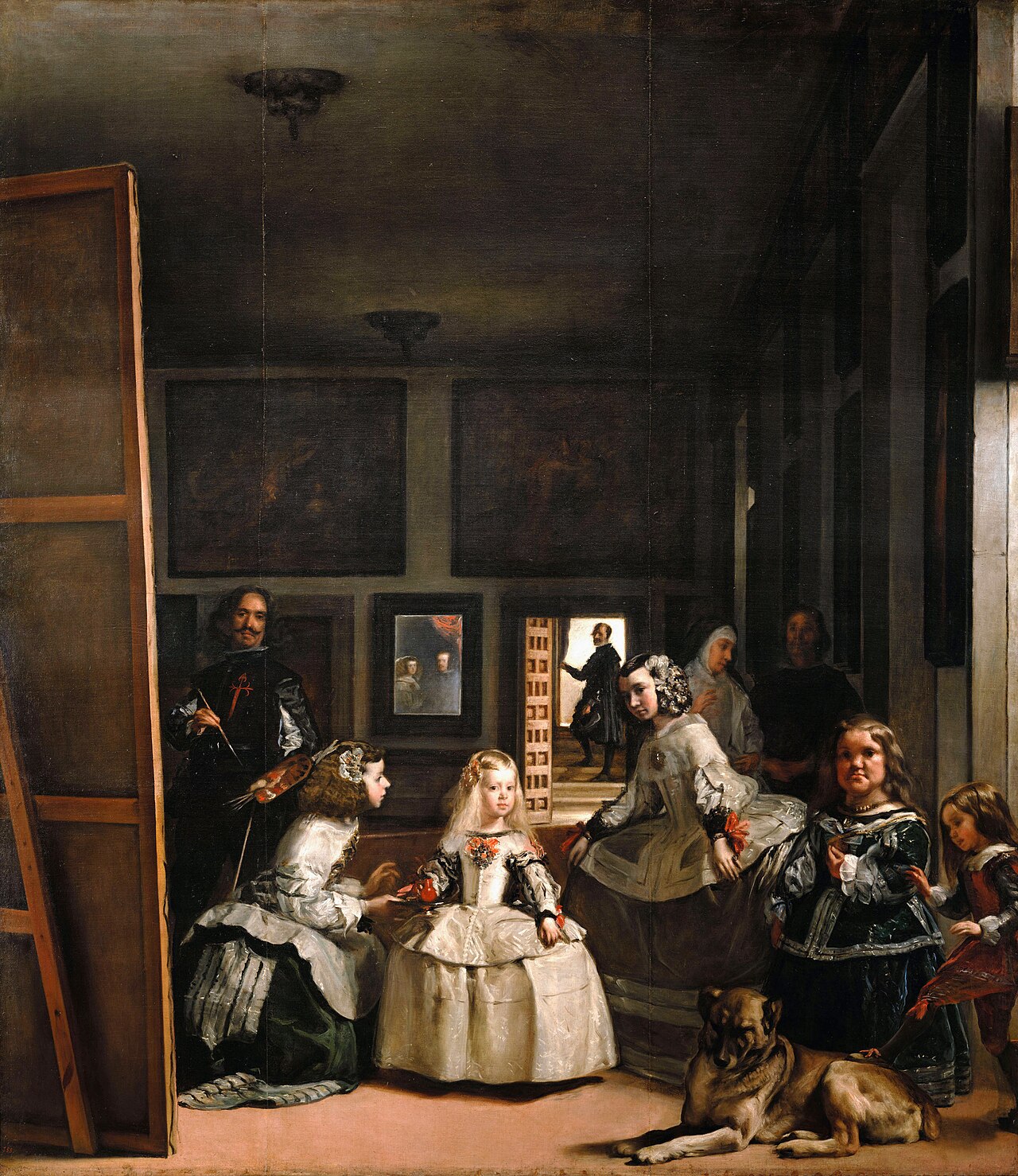
the royal couple occupy the same position (approximately) we occupy as the viewer. we look at the painter, who appears to look back at us.
the mirror matters because it gives an image of those outside the depicted room, we can not inspect what the painter is painting, so that matters too.
what does the mirror allow us to see that the rest of the picture leaves out?
imagine a headshot of someone, we do not see the photographer, the objects expression may depend on someone / something standing by the camera. the unseen things can organize things happening in the photograph. now if we imagine a mirror behind the subject, something outside the image has become visible inside it, indirectly.
relationships make representation possible, painter, model, image, spectator. the position outside the picture brings these relationships together, yet the occupant cant appear directly in the scene with the same capacity.
classical representation
what appears in the image: the people and objects shown
what makes this view possible: position which someone sees them
who is looking? at whom? from where? the picture contains things, it all depends on the relationships. thats why painting is difficult huh
chapter 2 The Prose of the World
self notes
foucault’s classical age is roughly 17^th & 18^th centuries. it does not mean ancient greece and rome.
| period | rough orientation | what it mean |
|---|---|---|
| classical antiquity | ancient greece $ rome | the ancient societies whose philosophy literature and art later Europeans studied |
| renaissance | 14th-16th centuries | rebirth renewed engagement with ancient culture |
| foucaults classical age | mid 17th to 1800 | configuration of knowledge that follows renaissance |
| foucaults modern age | 1800 | next major reorganization of knowledge |
around the middle of the 17th century until 1800, foucault identified two major breaks.
Renaissance Humanism: scholars recovered, translated, compared, commented on ancient texts. humanism means a scholarly movement involving ancient languages and learning, not just a diss on religion. read
the printing press helped circulating texts and images. artists also studied anatomy, perspective and ancient models. so renaissance wasnt only populated by fantastical comparisons. rijksmuseum
what is foucault doing?
he is concerned by the changes in the meaning of knowing. in his reconstruction:
renaissance knowledge privileges resemblance.
classical knowledge privileges representation and systematic ordering of identities and differences.
modern knowledge increasingly concerns histrocail development and the conditions of human knowledge. these are frameworks for investigating knowledge. stanford
connections: what else does this plant resemble? what might these connections reveal?
classification: which characteristics distinguish it from other plants? where does it belong?
development: how did the plant arise? what history explains it?
why these differences matter to foucault?
understanding something meant discovering its connections to other things through resemblance.
what counts as a meaningful connection? → knowledge?
the four similitudes
convenientia: proximity, contact and mutuality
aemulatio: distance, things mirror one another
analogy: relationships connect different things
sympathy: brings things together; antipathy preserves differences
signatures
hidden connections require visible marks, signatures make concealed affinities readable, “to know” is to be able to decipher these marks.
limits of the world
resemblences refer to resemblences, this relationship gives this potentially endless interpretation a bounded universe. magic and learned scholarship share an interpretive structure.
one resemblence needs other to confirm it, generating further interpretation. microcosm-macrocosm gives us a boundary: the human being, a little world mirrors a larger created universe. limits refer to the bounded field supporting knowledge.
like a hall of mirrors, reflections multiply, one leads our eyes to the other, but they are in the same enclosing space.
→ analogy for distinguishing the multiplication of connections from the boundary of the system.
for foucault, magic deciphers hidden affinities in nature, erudition deciphers inherited writings. they both seek concealed meaning through signs and correspondences. so observation and textual stuff can participate in one, rather than being a mixture of learning and superstition.
interpretive structure
| § | reading nature | reading a learned text |
|---|---|---|
| what is encountered? | feature of plant | passage in a book |
| what is assumed? | feature may indicate a hidden connection | the passage may contain knowledge requiring explanation |
| interpreter what do? | deciphers | deciphers |
| what is sought? | a concealed property | a concealed meaning |
encounter a sign → interpret → uncover
the writing of things
language belongs within the world being interpreted. natural marks and written words can demand deciphering, commentary connects texts with further texts
being of language
separation of words and things in Classical thought. modern literature later gives language an independent presence, without restoring Renaissance knowledge.
foucault: what made these connections count as knowledge?
the four similitudes are four different ways of connecting things
| form | imagine | what distinguishes it? |
|---|---|---|
| convenientia | parts of a landscape fitting together, soil, plants, animals | connection through neighbourhood |
| aemulatio | a flower being a counterpart of a star | mirroring without contact |
| analogy | saying that roots relate to a plant as a mouth relates to an animal | similarity between relationships |
| sympathy | two things are drawn toward one another by an affinity | attraction or influence |
root → plant mouth → animal
root and mouth doesnt need to look alike
sympathy isnt just feeling sorry for someone
signatures answers different questions from resemblences
- what connection supposedly exists?
- how could someone recognize that connection?
smoke and fire, you can see a campfire from afar without seeing the fire, from the smoke
this only illustrates a hidden thing and its visible indication, a renaissance signature may instead depend on resemblence.
lets for the presentation keep this distinct, connection vs. indication of connection
| term | meaning |
|---|---|
| similitude | resemblance |
| microcosm | a small world, version of a larger order |
| macrocosm | larger world or universe |
| hermeneutics | interpretation of meaning |
| exegesis | close interpretation of text |
| erudition | extensive scholarly learning |
| divination | discovering hidden knowledge thru signs |
| commentary | text explaining/interpreting another text |
| the being of language | the way language exists and functions |
these two thing resemble each other
- in what respect?
- why does it matter?
- what would it justify concluding?
a map resembles a territory in certain relationships, a cloud resembles a turtle in appearance. these two are very different conclusions.
what permits someone to just saying “these are alike” or just going “this is true”
this is why foucault yaps and rambles with the weird examples
foucault reconstructs the framework of renaissance, foucaults account of renaissance knowledge
chapter 3, representing
don quixote: he insists on reading the world through resemblances that dont convince anyone else. he tries to validate his chivalric books. when reality fails him, enchantment explains it, protecting the book. this is a breakdown of the allience between words and things. in the second part of the novel, characters recognize don quixote from reading his adventures: language gains power through its relationship to other writing.
book says this is what an adventure looks like. this situation is similar, so its an adventure. if it doesnt turn out to be an adventure, something is fucking with me and the adventures true nature.
the configuration changes. resemblance must be examined and justified before it counts as knowledge. like as if the library of knowledge just got rearranged.
new information within an arrangement ≠ new arrangement of information
foucault is concerned with the latter. resemblance lost its foundational authority, comparison now establishes identities and differences through measurement and order. Rationalism is the label, but doesnt explain it on its own. General science of order from making everything mathematical or mechanical.
tbc on rationalism and descartes
ferda keskin on foucault
Analytical philo is a thing of the 20th century, rather than a synthethic approach, it follows an analytical one
philosophy should be put in simpler words, logical approach, you dont have to refer to the history,
zizek is very well fed by analytical philo.
i.e. Kripke, possible world semantics
english speaking world UK & USA
hegel and lacan also have a huge influence on zizek, risky, very speculative, non tangible things are referred to while creating conceptual frameworks. i.e. world history, understanding the mind, basing your epistemology on this,
analyitcal is quite the opposite, (ferda keskin disagrees), he first searches for the argument. he thinks that philosophy part starts after the argument.
arguments are reasonings that fill the gaps of what you want to say about the world.
further step, you must add what your reasoning says about different fields of philosophy and how it changes them. if not, what youll end up doing will be very technical, like a language model.
foucault is very important because he changes paradigms
power, in relation to truth and knowledge, the matter of subject
compatible
two philosophies dont contradict eachother
coherence
two theories are not only compatible, they also support eachother
ferda keskin thinks that foucault is a very anticapitalist thinker. however there are radical differences between foucault and marx in concepts they used in their analyses. foucault analysed neo-liberalism.
marxs analysis was made through politico-economic terms, however his objection of capitalism is philosophical, ethic.
11:10 - 22:30 aptal orospu cocugu ilker canikligil
foucault is important. after discipline and punish, foucault’s analysis of the model of power claims that it restricts our freedoms by making us subjects in a constitutive relationship with capitalism.
if it werent for these relationships of power, capitalism wouldntve evolved to its current stage.
biopower
- disciplinary power
- governmentality
these analyses are not economic, however i.e. in his book “birth of biopolitics:” foucault explains historically why politico-economic science and statistics emerged while explaining governmentality.
foucault is a freedom thinker. thats how he wants to be read.
power-knowledge-subject matters, more importantly for foucault → subject and the freedom of the subject
now how does he complete marx? by analyzing power relations that marx lacks, and by showing the constitutive relation of power relations with capitalism, he shows that what restricts our freedom is exactly capitalism itself.
postmodernism is an american invention. modernity and modernism are opposite things. modernism is a critique of modernity.
modernity started with descartes in philosophy (17th century), foucault claims that that this period is the classical age and modernity started in the 19th century.
the individual must look within to be able to see that it exists.
the term “individual” was invented by modernity, its atomic and needs nothing but itself to exist.
in modern political philosophy, this holds a very important place.
social contract theory, the starting point is the individual.
foucault only mentions post-modern once, in the order of things.
renaissance, classical age and modernity, all have sets of rules on how to think about the world and how to do science. foucault says that we’re at the edge of the modern world and whats next is a post-modern world. so this is only a chronologic remark.
foucault par excellence defines himself as a perfect modern. modernity is an ethos. the critical attitude a person takes towards the era in which he or she lives.