Passivity and Tacit self-awareness
“try to get into the mood, and leave some things for just 2 hours; life will still be there - fortunately or unfortunately.”
The technical terms and key moves within the phenomenological method discussed today will reappear and might not immediately be easy to understand; we’re taking steps towards them. Prof. Jansen hopes we can lose (or not generate) anxiety over technical terms.
The terms (may) sound difficult, depending on how abstract they are, but we shouldn’t expect their reference to be so terribly complex.
Today, she will talk about the epoché, transcendental reduction, transcendental logic, etc.
The prof. hopes to show that these still point to something very concrete, rather than something abstract or formal.
The epoché is a methodical step in the phenomenological method; it is something used to signal a new kind of move that, in a way, does make use (re-appropriate) the idea of doubt. It brackets our beliefs, suspends them, so that we are able to take a look at them.
The epoché is something that can be performed - it is not mystical, or difficult - we just need to stop insisting that the world really exists; nobody’s doubting that, it’s not reasonable to doubt the existence of the world, but there isn’t really any use to just re-affirming the world. The epoché helps us figure out why we believe so strongly in the world; what justifies this belief.
We can exercise this locally within different disciplines - let’s say, in a therapeutic setting, you might exercise an epoché on what the patient is telling you about their world, and how it appears to them, and what is happening therein: what is important is not that you, as the therapist, know what is or is not real and are able to insist thereupon, but rather that you are able to bracket the belief or doubt about this existence, but rather about taking a good look at what is being reported, what that might mean, etc.
In philosophy, our epoché shouldn’t be local - it should be universal. It should bracket our beliefs of the world as a whole. For the duration of the phenomenological reflection, we put aside the question of what is and is not real, but how does it appear? How are our beliefs generated, legitimated, etc.?
There is something fundamentally unnatural about leaving the natural attitude, our usual mode of interaction with the world. Even Descartes wasn’t really doubting; it was a methodic doubt, but we are not free to doubt in the same way we are free to bracket. We need reasons to be skeptical of something, but we can bracket absolutely anything we want, we are free to reflect on it. ← we can do it with “complete freedom” (Ideas I, §§ 31, 32)
The next step is the transcendental reduction - it does not reduce in the sense of minimizing, but a leading back to (reducere) the very conditions of possibility (in a Kantian vein) for what we usually experience in the natural attitude, for that which we usually do not reflect on.
Once we forget that theories are productions of certain practices, that they lead back to subjects, the theory dies; we start thinking it is “the way things are” rather than something to be questioned.
“If one goes back from theory that is dead, so to speak, and has become objective, to the living, streaming life in which it arises in an evident manner, and if one reflectively investigates judging, deducing, etc., one will immediately be led to the fact that what stands before us as the accomplishment of thought and the intentionality and was able to show itself linguistically, rests upon deeper accomplishments of consciousness.” (Hua XVII, 373; Engl. APS, 32!)
Those thought operations and their results themselves, again, depend on other processes and activities of consciousness. The transcendental reduction is supposed to go back, and back, and back, until one hits the last level at which you can raise questions. That final realm, that which we hit below all else, is the domain of (what in this context is called) passivity.
Transcendental logic
How do we get to the conditions of possibility of cognition that lie in the subject? ← this is what Kant asks, and he gets his 12 categories back.
Husserl tries to re-ask this question for logic, but what he finds is something quite different to 12 categories and 2 kinds of sensibility; Husserl doesn’t throw out everything Kant comes up with, but he goes to a different and more rigorous answer.
Husserl, coming from mathematics, getting into philosophy, begins with logic, with his project ultimately growing bigger and bigger, concerning history, culture, etc.
”Don’t be afraid, we can only do a little bit, I’m trying to temper my ambitions (also towards myself)”
“It is impossible to understand what thinking (which is a highly built-up accomplishment [a highly complex practice]) is in the specific sense in order to be able to be expressed by language and universal words and in order to provide a science, a theory, if we do not go back prior to this thinking, back to those acts and accomplishments that make up the most expansive part of our life. For not only does a pre-theoretical life reside in this expansiveness, but a pre-linguistic life as well, one that immediately ceases to be in its original, primitive peculiarity with every expression.” (Ibid., emphasis prof’s)
So, we also have to somehow push the limits of what we can capture with language; we cannot use language as if it is a transparent medium, merely expressing certain thoughts. Most people present here know more than one language, and know very well how some things are easier to express in some language, rather than another. We cannot get rid of language altogether, but we must push the analysis as far as we can. → if you really want to do proper logic, not just use logics, but ask about their validity, their origins, you have to push towards a reflection on a pre-theoretical, pre-linguistic experience.
That experience you can’t really gather an understanding of, if you are not a being that somehow has experienced this. That’s why phenomenology is talked about as a discussion of ‘first-person experience’ - a somewhat tautological statement to a phenomenologist, as there is experience which is not, somehow, first-person.
All of us need to be experiencing subjects in order to reflect on the modes of experiencing etc.
“External perception [perception of things you know to be distinct from yourself] is a constant pretension to accomplish something that, by its very nature, it is not in a position to accomplish.” (Hua 11, 3)
Strictly speaking, one only perceives a certain side, profile, shading, adumbration, Abschattung.
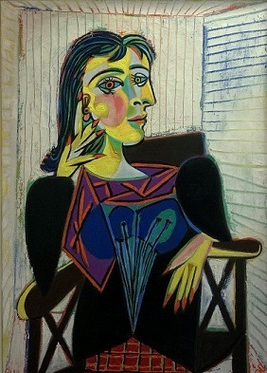
Pablo Picasso, Dora Maar (1937).
The above painting is an attempt to show something from multiple sides at the same time. If this were to unfold in time, it would look normal, but here we see in one go what is really a continuous process.
There is a sense in which we do not perceive objects, but, on the other hand, there is a way in which we do not merely see ‘images’ devoid of objects. Perception is often wrongly considered a ‘simple’ act. It is incredibly complexity. Pressing on the initial insight that there is a kind of multiplicity involved in every moment of an unfolding perceiving, the perceiving of different profiles on a perceptual object, for instance; we also have to add the other moment of perceptual experience, which is experiencing sides and profiles as sides and profiles of something.
There is a plurality and a unity; the question becomes, if we don’t just say, as in the natural attitude “I see the lemon because it’s there,” but instead pay attention to the dynamic that is part of the unfolding perceiving, a unity that emerges in the plurality of the different moments of perceiving, the different adumbrations, profiles, and so on, and so forth.
It’s also part of the perceptual experience, f.e. in visual perceptual experience, that the sights that are, in a certain sense, invisible to me, are still (what phenomenologists would call) ‘co-apprehended.’ It’s not like, if you walked around the professor, you’d be surprised to notice that she has a back-side.
You do not merely see what you see, but you also have certain expectations of things you do not yet, but could possibly see.
If you see half a green apple, you still expect it to be green on the side you don’t see; or at least not purple.
This gives us an insight into the fundamental structure of perceiving, and of perceived objects, namely, that each of the sides motivate expectation of the other sides; this speaks to the emergence of said unity from plurality.
These are so-called ‘passive expectations’, of which we tend to become conscious only once they are violated, even if we mostly act based on these expectations.
“Generally speaking, perception is original [original in the sense of having an immediateness and directness] consciousness. We have, however, a curious schism in external perception [the complexity involves an abyss between different dimensions] : Original consciousness is only possible in the form of an actually and genuinely original conscious-having of sides and a co-conscious having of other sides that are precisely not originally there. [simultaneously having consciousness of the sides that are (visible and immediate, and directly present) and (invisible and non-immediate and not directly there)] I say co-conscious, since the non-visible sides are certainly also there somehow for consciousness, “co-meant” as co-present. But they do not appear as such, genuinely.” (Hua 11, 4)
There is sometimes a conscious “I wonder how that looks from a different angle,” but that is fundamentally different from the passive (in the sense of not being consciously steered) expectation/exploration being established.
Time
One dimension of this unity of the plurality is an understanding of the temporality of perception.
Therefrom we get to the (in)famous explorations of Internal Time Consciousness.
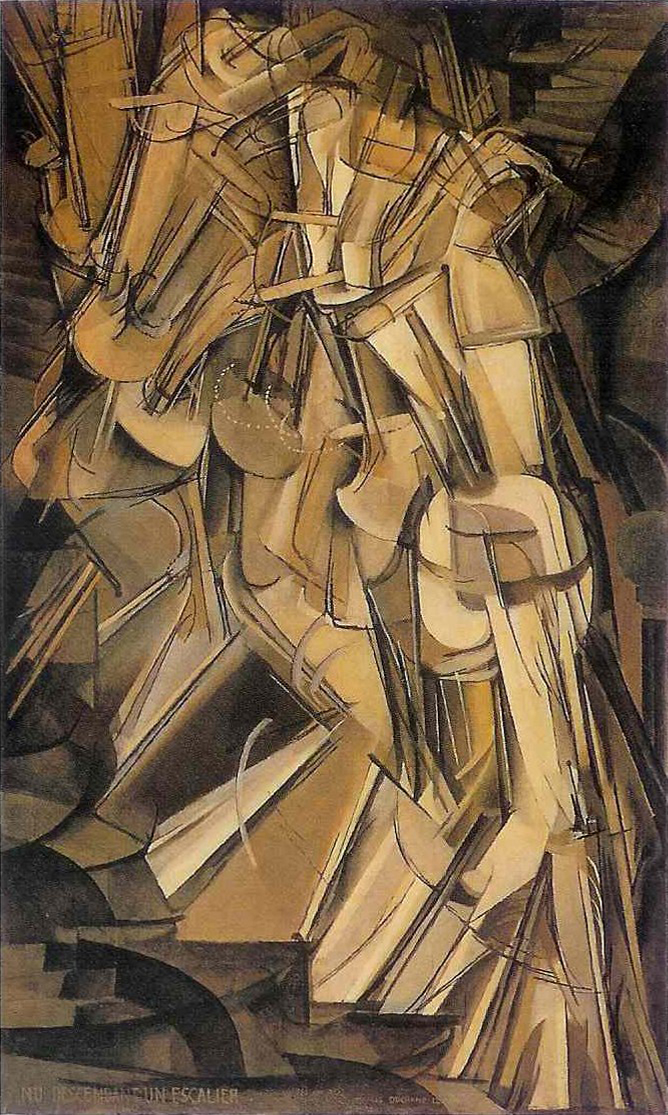
Marcel Duchamp, Nude Descending a Staircase (1912)
Another attempt to display time in simultaneity.
Music, on the other hand, tends to highlight the temporality of experience.
The NOW is constituted by:
- Retention
- Primordial-impression (Urimpression)
- Protention
You cannot easily complete a sentence without retaining its beginning; this process goes wrong, for instance, when one is nervous or excessively self-conscious. When all goes well, we complete a phrase effortlessly.
Even when listening to music (like with the thing about the invisible sides we still expect), we still have some expectations for what might be about to happen.
Meaning always retains, and it points further.
One’s exploration of a certain matter is partly a result of their own will, but that will is also ‘called forth’ by something visible. What is visible might call one to see more.
The reason this is relevant to logic is because we learn something about how we structure perception; it is the beginning of comprehending how biases emerge; …