From this situation some questions arise; if you work in a tradition that is determined by the rise of natural science in modernity and it is plausible that science is such a discourse that reaches beyond the arche of discourse. We should try to imitate science as much as possible (?)
[If i hear this thesis again I’m going to lose my mind <3 we have heard the arche beyond discourse five billion times at this point]
Frege’s logicist attempt at explaining mathematics is an attempt to show that mathematics is nothing but logic; if mathematics has any normativity - that there are ‘right mathematical statements,’ - it derives from the normativity of logic.
The topic for today is “how do Frege, Russell, and Strawson think of this way of breaking out of discourse to an arche beyond discourse,” and if they are trying to do that, they need an immediate/transparent relation between speaker/thinker and what we speak/think of.
Nothing should distort their view of that arche.
Thinking and speaking both use some form of language; thus, an ambition to establish a transparent/immediate relation necessitates the usage of language, which means language itself must also become a transparent medium, mediating between actor and object.
There are two levels for this discussion:
(1) the precise analyses and doctrines, e.g. about ‘The so-and-so.‘
and
(2) the general position with regard to subject-object relation
Frege
‘Helder DS is Helder DS’ - not informative
’Helder DS is the dean of the Institute’
→ “the dean of the Institute”
reference sense
object mode of presentation
’how it is given’
There is also the ‘idea’ → the purely subjective impression (emotions).
Russell
- Epistemology is the knowledge of things.
There are two kinds of knowledge of things (a) knowledge by description (b) by acquaintance. He is an empiricist: all our knowledge relies on acquaintance; we only have acquaintance with sense-data (memory, introspection, the Self). So, we are never acquainted with physical objects.
If you know something by acquaintance, you don’t really have a way to express it; you can only show it. “You know the color perfectly and completely when you see it; no further knowledge is even theoretically possible.” → No knowledge of description of sense-data. - Language
We do not have knowledge of description of sense-data; no mode of presentation. → we use expressions without Frege’s sense, e.g. “this”: refers to a sense-datum. Normal names (like Bismarck) are not logical proper names; only “this” or “I” are, as they refer to something one is acquainted with.
Thus, of physical objects we only have knowledge by description.
→ We know that it is “the so-and-so,” the single object (and no more) that has this property.
”This table” (while pointing to a table) = The (one) object that causes this sense-datum. - What about sentences with definite descriptions?
”The first chancellor of the GE is an astute diplomat”
= the actual object which was the first chancellor of the GE was an astute diplomatist
= there is an actual object which was the first chancellor of the GE and that object is an astute diplomatist
= there is an x such that (x was the first chancellor of the GE and x was an astute diplomatist) ∧ (for all y, if y was the first chancellor of the GE, then y = x) - How then, do we resolve Frege’s puzzle about identities? There is a different cognitive value to “a = a,” and “a = b”
Helder DS = Helder DS
There is an x (such that x is called HDS and x is called HDS)
Helder DS is dean of the HIW
There is an x (such that x is called HDS and x is dean of the HIW) - What about things that don’t exist? We can meaningfully talk about things that don’t exist:
“The king of France is bald” if meaningful seems to talk about the king of France
if true
”Round squares do not exist” if meaningful seems to talk about round squares
is true and therefore seems to talk about round squares
Meinong says that there is a realm of the non-real. Meinong’s jungle.
Not if “the king of France is bald” = there is an actual object that is KF and bald
there is an x that is KF and bald
Not if “Round squares do not exist” = there is not an actual object that is round and square
There is not an x that is round and square
Strawson
He distinguishes between [sentences/expressions] vs. [the use of a sentence/expression], vs. [the utterance of a sentence/expression].
A sentence/expression do not have meaning (true/false) or refer, respectively.
The use thereof can be used to state some truth-value, or refer to something.
An utterance is the individual usage within a certain context.
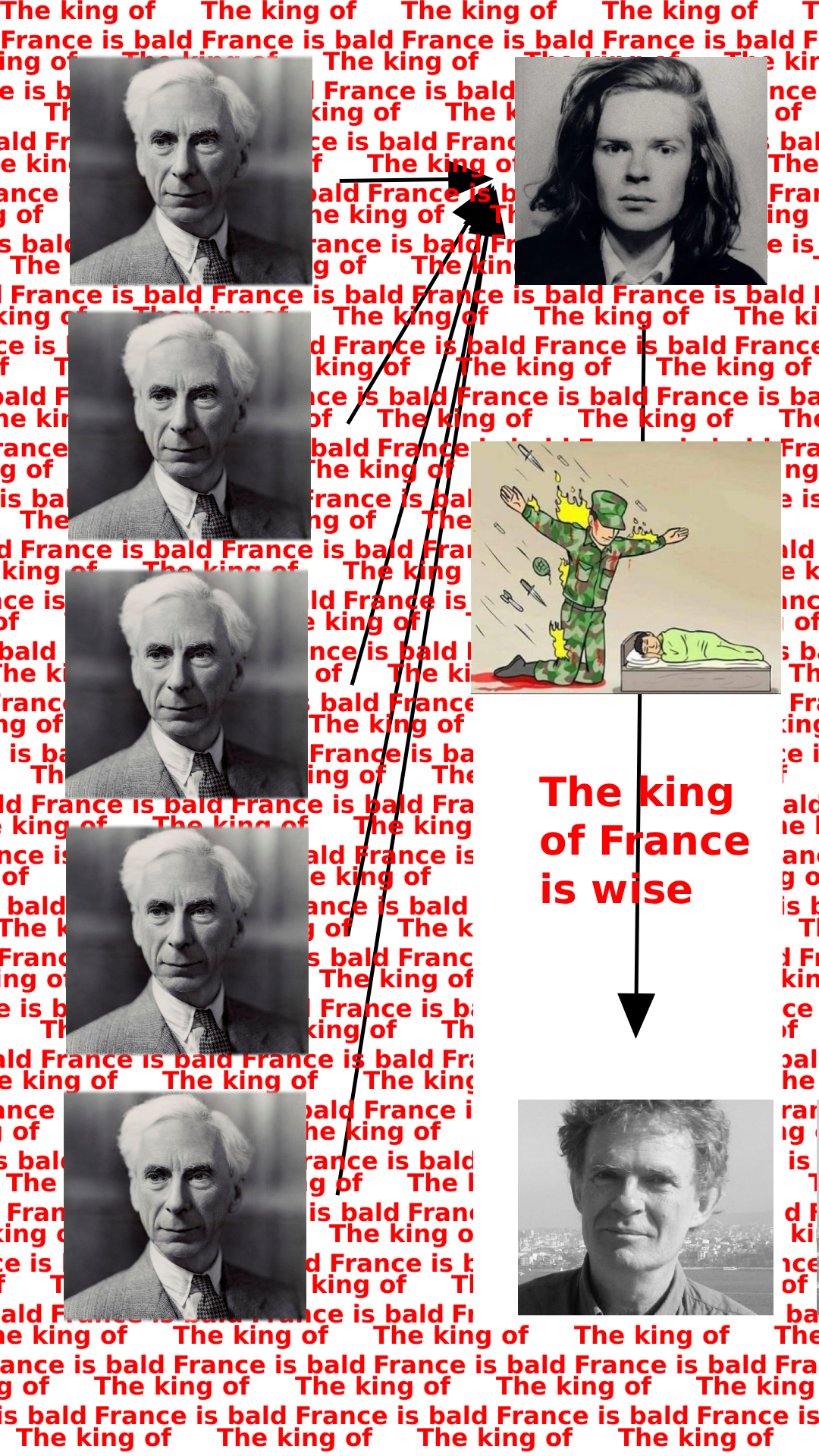
Payoff or something
Frege
For Frege, the object that is the reference is presented (given!) through the sense of the expression. Thus, we never encounter “naked” reality.
There is no immediate/transparent relation between speaker and object, given that the object is presented only for those having the words/expression, those knowing a certain language.
(Sapir-Whorf hypothesis heheheheheheh)
Frege avoids relativism by neo-Platonism (thoughts are basically ideas for him; ideas are thoughts to him).
Frege and Russell both see knowledge as mediated by knowledge, though with some knowledge being an immediate relation with the object.
Russell ofc is knowledge by acquaintance
Strawson does not talk about relation with object and does not deny the immediate relationship with the object.
He relativizes it, by introducing a distinction between a sentence and its use, asserting and implying.
Language is a matter of communication/interaction between speaker and listener
communication is not always a matter of assertion but of implying
stresses intersubjectivity of language
focus not on the relation between speaker and object
focus on the relation between speaker and listener:
how would a listener react to what the speaker says
The listener presumes the speaker is using expressions/sentences correctly.
Grice (Strawson contemporary, coauthors of articles): gricean maxims; patrick stewart surprises fan with life threatening illness. But they come up with ‘implicatures:’ what is not asserted but implied.
If your car breaks down and someone tells you ‘there’s a garage around the corner’ you will probably assume that garage has petrol/servicemen able to help.